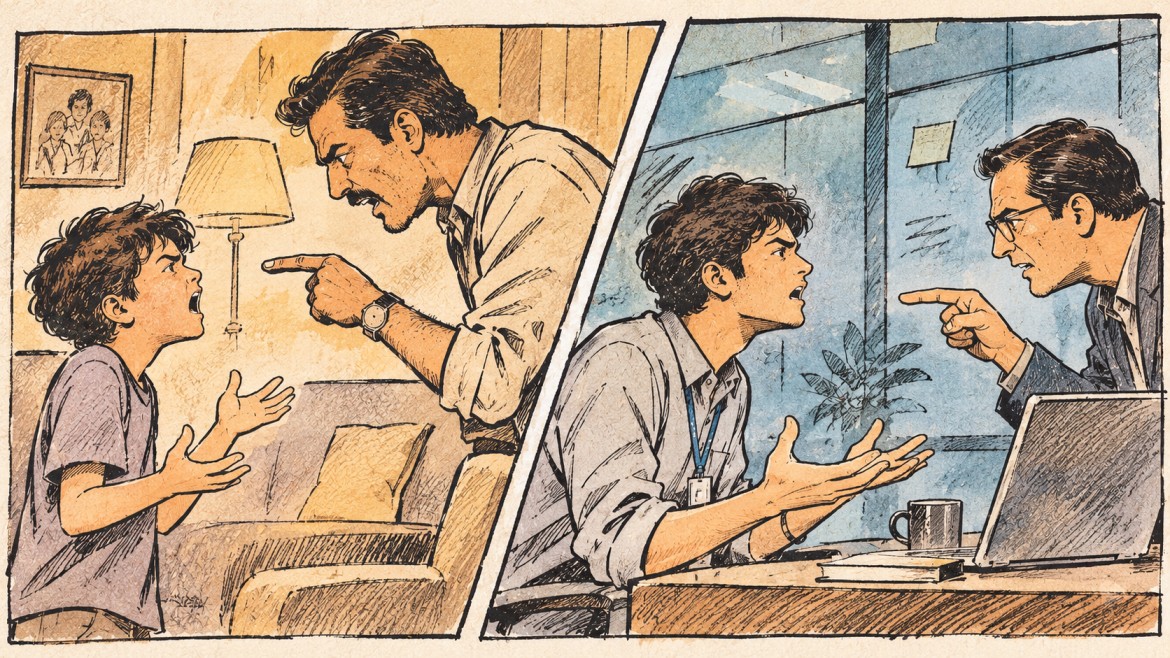
Your First Manager Was at Home
Evolusis Labs · 25 November 2026
Why do some young professionals struggle with feedback at work? Research links childhood experiences to rejection sensitivity, leadership and resilience, and shows how self-awareness can help.
How Childhood Shapes Feedback, Resilience and Self-Awareness at Work
Why Do Some Young Professionals Struggle With Feedback at Work?
Two new hires get the same critical feedback. One sees a chance to grow. The other hears rejection, and a simple disagreement turns personal. For HR and L&D teams onboarding early-career talent, the question matters: how much of workplace behaviour reflects today, and how much reflects what we experienced before?
Self-awareness is part of the puzzle. Most people believe they are self-aware, but one research programme estimates only 10 to 15% actually are (Eurich, 2018).
What Is Behind These Workplace Behaviours?
In short, early experiences can shape how people handle authority, feedback and pressure. Three concepts explain most of it:
- Work-family crossover: parents' work stress and satisfaction carry into the home and shape how children view work (Steiner et al., 2022).
- Rejection sensitivity: a tendency to expect, perceive and overreact to rejection (Downey & Feldman, 1996).
- Intergenerational transmission: harsh treatment early in life can resurface later in leadership behaviour (Kiewitz et al., 2012).
What Does the Research Say About Childhood and Workplace Behaviour?
- Work attitudes: parents' work-to-family conflict and enrichment are linked to how central work becomes to their children's identity (Steiner et al., 2022).
- Feedback: employees with anxious attachment tend to seek and accept less feedback (Allen et al., 2010). Rejection-sensitive people also read ambiguous behaviour as intentional rejection, a pattern linked to rejecting parenting (Downey & Feldman, 1996).
- Leadership: managers who experienced more family undermining in childhood were more likely to be abusive supervisors, but self-control reduced the effect (Kiewitz et al., 2012).
- Resilience: resilience training has a modest positive effect on performance and well-being, with coaching working best (Vanhove et al., 2016).
The fine print: effects are modest, little of this research is Gen Z-specific, and no study I found shows self-awareness directly causes resilience. Treat childhood as one contributing factor, not a rule.
What Does This Mean for Employee Development?
Defensiveness about feedback is not always an attitude problem. For some employees it reflects deeper patterns. Leaders carry their own history into how they manage. And employee resilience is better built through support than through demands to "toughen up".
How Can Individuals, Managers and Organisations Respond?
- Individuals: ask colleagues how your impact lands, not just how you feel about it (Eurich, 2018).
- Managers: state the intent behind feedback clearly so it is harder to read as rejection (an inference from Downey & Feldman, 1996).
- Organisations: invest in coaching-led resilience and self-awareness programmes for early-career hires (Vanhove et al., 2016).
Key Takeaway
People bring their personal histories to work. Self-awareness will not erase them, but it can help young professionals respond to the present instead of reliving the past. Organisations that pair feedback skills with coaching can turn fragile first reactions into lasting resilience.